
Planning a trip? Our pharmacist-led travel clinic in Esher offers personalised travel health consultations.
Introduction
Whether you're planning a relaxing beach holiday, a backpacking adventure through Asia, a safari in Africa or travelling for business, preparing for your trip involves more than booking flights and packing your suitcase.
Many destinations around the world have health risks that are uncommon in the UK. Diseases such as hepatitis A, typhoid, rabies and yellow fever remain common in some countries, while malaria continues to affect travellers every year.
Fortunately, many travel-related illnesses are preventable through a combination of travel vaccinations, malaria prevention, insect bite avoidance and personalised travel health advice.
At Wallis Jones Pharmacy, our pharmacist-led travel clinic provides tailored travel health consultations based on your destination, medical history, planned activities and previous vaccination history.
Why Travel Health Matters
There is no single set of travel vaccinations that suits everybody. The advice appropriate for one traveller may be very different from the advice appropriate for another travelling to the same country.
Travel health recommendations usually depend on a combination of factors:
- The country you are visiting
- The specific regions within that country
- How long you are staying
- The season and time of year
- The type of accommodation you are using
- Your planned activities
- Any medical conditions you have
- Whether you are pregnant or breastfeeding
- Your previous vaccination history
Every traveller is different
Someone spending two weeks in a city hotel may have very different travel health requirements from someone backpacking through rural areas for three months. Travel health advice should therefore be personalised to your individual itinerary.
When to Book
Ideally, travellers should arrange a travel health consultation approximately four to six weeks before departure. This allows time for vaccines to become effective and for multi-dose courses to be completed where necessary.
Some vaccines are given as a course of two or more doses over several weeks, and antimalarial tablets may need to be started before you travel, so earlier appointments give the most flexibility.
Travelling soon? Don't assume you've left it too late
Even last-minute travellers may still benefit from vaccination, malaria prevention and personalised travel advice. If your trip is only days away, it is still worth speaking to a pharmacist.
Your Travel Consultation
A travel health consultation is a structured conversation about your trip and your health. It helps the pharmacist build an accurate picture of your individual risk before making any recommendations.
What the pharmacist will review
- Destination(s)The countries included in your trip.
- Areas being visitedUrban, rural or remote regions.
- DurationHow long you will be away.
- Purpose of travelHoliday, business, volunteering or visiting family.
- Planned activitiesTrekking, safari, diving, altitude or fieldwork.
- Previous vaccinationsWhat you have already had, and when.
- Medical conditionsExisting health problems relevant to travel.
- Regular medicinesPrescription and over-the-counter medicines.
- AllergiesIncluding any previous vaccine reactions.
- Pregnancy or breastfeedingWhere relevant to your assessment.
We'll then carry out an individual travel health risk assessment and recommend appropriate vaccinations, malaria prevention and other precautions for your trip.
Travel Vaccine Overview
The vaccines below are among those most commonly discussed in UK travel clinics. Which of them, if any, are appropriate for you is decided during your consultation. Select a vaccine to jump to the relevant section.
Td/IPV (diphtheria, tetanus, polio)
- Type
- Bacterial (diphtheria, tetanus) and viral (polio)
- Where is it found?
- Worldwide
- Transmitted by
- Respiratory droplets; tetanus through contaminated soil/wounds
- Schedule
- A booster may be recommended if the last tetanus-containing vaccine was more than 10 years ago, particularly when travelling to areas where medical facilities may be limited. This depends on your vaccination history, destination and travel circumstances
- Length of immunity / protection
- Routine vaccination provides long-term protection; additional vaccination may be recommended depending on travel circumstances
Hepatitis A
- Type
- Viral
- Where is it found?
- Worldwide, particularly areas with poorer sanitation
- Transmitted by
- Contaminated food and water; close contact
- Schedule
- 2 doses
- Length of immunity / protection
- At least 25 years, likely much longer
Typhoid
- Type
- Bacterial
- Where is it found?
- South Asia, Southeast Asia, Africa, Central/South America
- Transmitted by
- Contaminated food and water; faecal-oral transmission
- Schedule
- 1 dose
- Length of immunity / protection
- Approximately 3 years for the injectable vaccine
Hepatitis B
- Type
- Viral
- Where is it found?
- Worldwide
- Transmitted by
- Blood, blood products and bodily fluids
- Schedule
- 3 doses: 0, 1 and 6 months; accelerated schedules may be appropriate in some circumstances
- Length of immunity / protection
- Long-term protection; routine boosters generally not required for immunocompetent people
Rabies – pre-exposure
- Type
- Viral
- Where is it found?
- Worldwide, particularly areas where rabies is present
- Transmitted by
- Animal saliva through bites, scratches or other exposures
- Schedule
- Usually 3 doses: day 0, day 7 and day 21 or 28; alternative licensed schedules may apply depending on the vaccine and circumstances
- Length of immunity / protection
- Protection is long-lasting; booster requirements depend on ongoing risk. Pre-exposure vaccination does not remove the need for urgent post-exposure assessment and treatment
MenACWY
- Type
- Bacterial
- Where is it found?
- Worldwide; increased risk in parts of sub-Saharan Africa and during Hajj/Umrah
- Transmitted by
- Respiratory droplets/close contact
- Schedule
- 1 dose
- Length of immunity / protection
- Protection wanes over time; a booster may be recommended every 5 years for travellers who remain at continued risk
Japanese encephalitis
- Type
- Viral
- Where is it found?
- Rural/agricultural areas of South and Southeast Asia and parts of the Western Pacific
- Transmitted by
- Mosquitoes, mainly Culex species, often active at dusk/night
- Schedule
- 2 doses: day 0 and day 28; an accelerated 0 and 7-day schedule may be available for eligible adults
- Length of immunity / protection
- Booster may be recommended for ongoing risk
Cholera (oral)
- Type
- Bacterial
- Where is it found?
- Areas with inadequate sanitation, particularly parts of Africa and Asia
- Transmitted by
- Contaminated food and water
- Schedule
- 2 doses of Dukoral, at least 1 week but less than 6 weeks apart
- Length of immunity / protection
- Approximately 2 years
Tick-borne encephalitis (TBE)
- Type
- Viral
- Where is it found?
- Forested/grassland areas of Central, Eastern and Northern Europe and parts of Asia
- Transmitted by
- Infected tick bites; occasionally unpasteurised dairy products
- Schedule
- 3 doses; timing and accelerated schedules depend on the vaccine used
- Length of immunity / protection
- Booster timing depends on age, vaccine and ongoing risk
Dengue
- Type
- Viral
- Where is it found?
- Tropical/subtropical areas of Asia, the Americas, Africa and the Pacific
- Transmitted by
- Aedes mosquitoes, mainly daytime biting
- Schedule
- 2 doses: 0 and 3 months
- Length of immunity / protection
- Protection lasts for several years; duration varies according to individual circumstances and evidence
| Vaccine | Type | Where is it found? | Transmitted by | Schedule | Length of immunity / protection |
|---|---|---|---|---|---|
| Td/IPV (diphtheria, tetanus, polio) | Bacterial (diphtheria, tetanus) and viral (polio) | Worldwide | Respiratory droplets; tetanus through contaminated soil/wounds | A booster may be recommended if the last tetanus-containing vaccine was more than 10 years ago, particularly when travelling to areas where medical facilities may be limited. This depends on your vaccination history, destination and travel circumstances | Routine vaccination provides long-term protection; additional vaccination may be recommended depending on travel circumstances |
| Hepatitis A | Viral | Worldwide, particularly areas with poorer sanitation | Contaminated food and water; close contact | 2 doses | At least 25 years, likely much longer |
| Typhoid | Bacterial | South Asia, Southeast Asia, Africa, Central/South America | Contaminated food and water; faecal-oral transmission | 1 dose | Approximately 3 years for the injectable vaccine |
| Hepatitis B | Viral | Worldwide | Blood, blood products and bodily fluids | 3 doses: 0, 1 and 6 months; accelerated schedules may be appropriate in some circumstances | Long-term protection; routine boosters generally not required for immunocompetent people |
| Rabies – pre-exposure | Viral | Worldwide, particularly areas where rabies is present | Animal saliva through bites, scratches or other exposures | Usually 3 doses: day 0, day 7 and day 21 or 28; alternative licensed schedules may apply depending on the vaccine and circumstances | Protection is long-lasting; booster requirements depend on ongoing risk. Pre-exposure vaccination does not remove the need for urgent post-exposure assessment and treatment |
| MenACWY | Bacterial | Worldwide; increased risk in parts of sub-Saharan Africa and during Hajj/Umrah | Respiratory droplets/close contact | 1 dose | Protection wanes over time; a booster may be recommended every 5 years for travellers who remain at continued risk |
| Japanese encephalitis | Viral | Rural/agricultural areas of South and Southeast Asia and parts of the Western Pacific | Mosquitoes, mainly Culex species, often active at dusk/night | 2 doses: day 0 and day 28; an accelerated 0 and 7-day schedule may be available for eligible adults | Booster may be recommended for ongoing risk |
| Cholera (oral) | Bacterial | Areas with inadequate sanitation, particularly parts of Africa and Asia | Contaminated food and water | 2 doses of Dukoral, at least 1 week but less than 6 weeks apart | Approximately 2 years |
| Tick-borne encephalitis (TBE) | Viral | Forested/grassland areas of Central, Eastern and Northern Europe and parts of Asia | Infected tick bites; occasionally unpasteurised dairy products | 3 doses; timing and accelerated schedules depend on the vaccine used | Booster timing depends on age, vaccine and ongoing risk |
| Dengue | Viral | Tropical/subtropical areas of Asia, the Americas, Africa and the Pacific | Aedes mosquitoes, mainly daytime biting | 2 doses: 0 and 3 months | Protection lasts for several years; duration varies according to individual circumstances and evidence |
Dengue eligibility note
Dengue vaccination is generally recommended for eligible travellers who have previously had dengue infection and are travelling to an area where dengue presents a risk. In exceptional circumstances, vaccination may be considered following specialist advice. Suitability requires an individual assessment and can depend on factors including age, previous dengue infection, pregnancy, breastfeeding, immune status and travel destination. It is not a vaccine that every traveller to a tropical destination should automatically receive.
Oral cholera vaccine
Oral cholera vaccination is given for cholera risk. It is not a general traveller's diarrhoea vaccine and should not be relied upon to prevent all causes of traveller's diarrhoea.
Hepatitis A
What is hepatitis A?
Hepatitis A is a highly infectious viral infection that affects the liver. It is usually spread through contaminated food or water, or through close contact with someone who is already infected.
Where is it found?
Hepatitis A occurs worldwide, but risk is generally higher in areas where sanitation and food hygiene standards may be poor, including:
- The Indian subcontinent
- Sub-Saharan Africa
- North Africa
- Parts of the Far East
- South and Central America
- The Middle East
Who may be at greater risk?
- Travellers staying with local populations, or visiting friends and relatives
- Frequent travellers
- Long-stay travellers
- Travellers going where sanitation and food hygiene may be poor
- Certain people with existing liver disease
- People who may be exposed through their occupation
- Travellers to outbreak areas with limited access to safe water and healthcare
Symptoms
- Fever
- Loss of appetite
- Nausea
- Malaise (a general feeling of being unwell)
- Jaundice (yellowing of the skin and eyes)
Illness tends to become more serious with increasing age, and recovery may take weeks or months.
Prevention
Careful food and water hygiene remains important for all travellers. Vaccination is often discussed alongside these precautions rather than instead of them.
How long does protection last?
A completed hepatitis A vaccination course can be expected to provide protection for at least 25 years, and probably longer. Current UK guidance may recommend a booster at 25 years for people with ongoing risk.
Hepatitis B
Hepatitis B is a viral infection of the liver that is transmitted through infected blood and body fluids.
Who may be at greater risk?
Long-stay travellers; healthcare and humanitarian workers; people who may need medical or dental treatment overseas; people participating in contact sports; people who may have new sexual partners; people undergoing tattooing or piercing where sterile equipment cannot be guaranteed; and people who inject drugs.
Prevention
- Practising safer sex, including using condoms
- Ensuring sterile equipment is used for any medical, dental, tattooing or piercing procedure
- Avoiding sharing needles, syringes or other injecting equipment
- Avoiding sharing razors, toothbrushes or other items that may be contaminated with blood
- Taking appropriate precautions around any exposure to blood or body fluids
Hepatitis B vaccines can be given alone, or in certain combination vaccines, depending on what is clinically appropriate for you.
Typhoid
Typhoid fever is caused by the bacterium Salmonella Typhi and is usually acquired through contaminated food or water. Globally, disease occurs particularly in areas where sanitation and access to clean drinking water are limited.
Many travel-associated cases reported in the UK occur among people visiting friends and relatives in India, Pakistan and Bangladesh.
Symptoms
- Fever
- Headache
- Muscle and joint pain
- Constipation or diarrhoea
- Rash
Complications can include intestinal bleeding and perforation, so medical assessment is important if you become unwell during or after travel.
Vaccination doesn't replace food and water precautions
Typhoid vaccination protects against typhoid but not paratyphoid, and no vaccine is fully protective. Careful food and water hygiene remains important throughout your trip.
Rabies
Rabies is a viral infection transmitted through the saliva of an infected animal. Exposure usually happens through:
- A bite
- A scratch
- Saliva contacting broken skin
- Saliva contacting the eyes, nose or mouth
Urgent action
Rabies is almost always fatal once symptoms develop — but prompt treatment after exposure can prevent the disease.
Pre-exposure vaccination
Pre-exposure rabies vaccination usually involves 3 doses given on days 0, 7 and 21 or 28. Alternative licensed schedules may apply depending on the vaccine, your age and your circumstances.
Protection is long-lasting, but the need for further vaccination or monitoring depends on your ongoing exposure risk.
Vaccination before travel does not remove the need for urgent treatment
Pre-exposure vaccination does not eliminate the need for urgent medical assessment after a possible rabies exposure. Post-exposure treatment may still be required following a bite, scratch or other significant exposure.
Who should particularly consider pre-travel vaccination?
- Long-stay travellers
- Travellers to remote areas
- People with limited access to medical care while away
- Animal workers
- Cyclists
- Runners
- Travellers undertaking activities that increase animal exposure
Bitten or scratched by an animal abroad?
Act immediately — thorough wound care in the first minutes matters, and medical assessment should follow the same day where possible.
- 1Wash immediatelyFlush the wound under running water for several minutes and wash thoroughly with soap or detergent and water.
- 2DisinfectApply an appropriate disinfectant such as iodine solution or 70% alcohol if available.
- 3CoverApply a simple loose dressing.
- 4Seek urgent medical helpSeek medical treatment locally as soon as possible. Do not wait until you return to the UK.
Urgent medical assessment is required even if you received rabies vaccination before travelling.
Yellow Fever
Yellow fever is a viral infection transmitted predominantly by certain day-biting mosquitoes. Risk exists in parts of Africa, South America, Central America and Trinidad.
Whether there is a meaningful risk for you depends on:
- Your destination
- The intensity of transmission in that area
- The season
- The duration of your stay
- Your planned activities
- Your vaccination status
International Certificate of Vaccination or Prophylaxis (ICVP)
Key information
Some countries require proof of yellow fever vaccination for entry under the International Health Regulations. Requirements vary according to the traveller's itinerary and the countries recently visited. For most travellers one dose provides lifelong protection, and a correctly completed certificate is generally valid for life under the International Health Regulations.
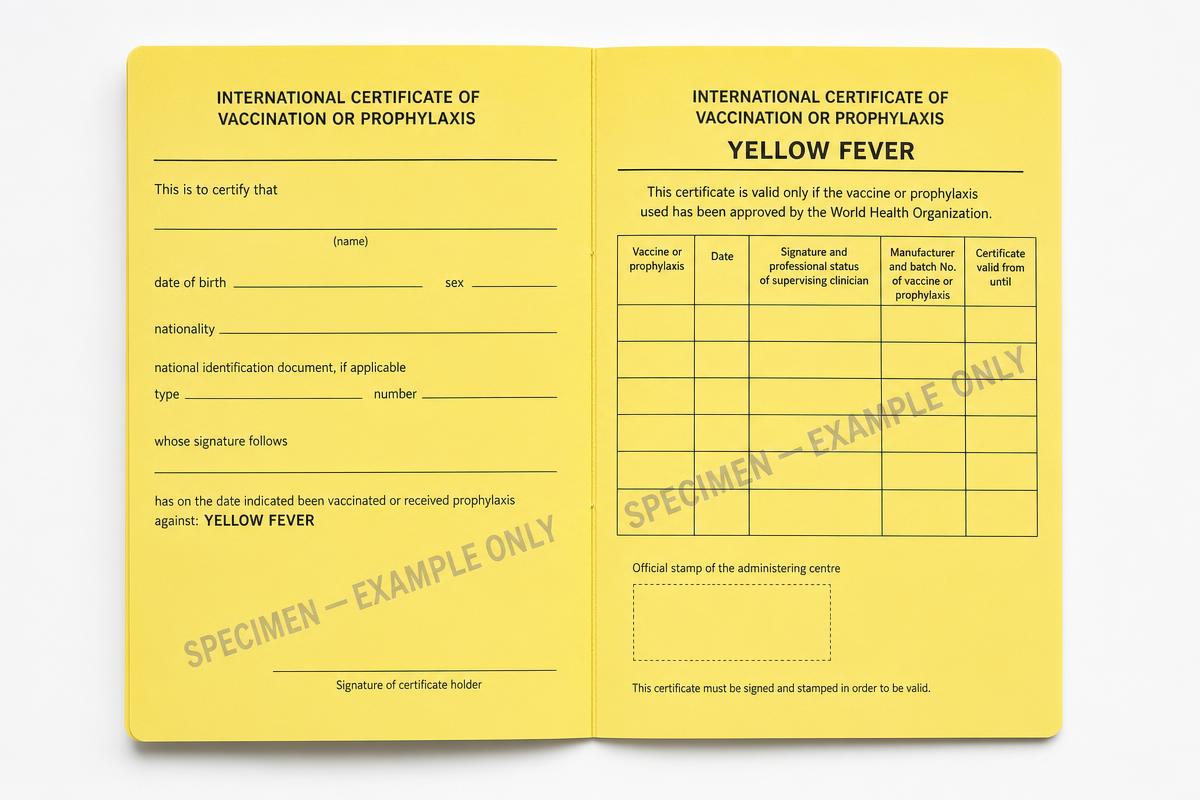
Important yellow fever safety information
Yellow fever vaccine is a live vaccine and requires an individual clinical risk assessment. It is not the case that everyone travelling to a country with yellow fever risk should be vaccinated.
Yellow fever vaccination is given using a live vaccine such as Stamaril®. Before vaccination, the healthcare professional will carry out an individual risk assessment, because the vaccine is not suitable for everyone.
Special consideration, additional precautions or contraindications can apply to:
- People who are immunocompromised
- Very young infants
- Pregnancy
- Breastfeeding
- People aged 60 and over
- People with certain thymus disorders
- People who have had a previous severe vaccine reaction
Your pharmacist will assess suitability individually and discuss the options available for your itinerary, including certificate requirements and, where appropriate, referral.
Japanese Encephalitis
Japanese encephalitis (JE) is transmitted by mosquitoes in parts of Asia and the Western Pacific. For most short-term urban travellers, the risk is very low.
When can risk increase?
- Long stays
- Rural travel
- Rice-growing and irrigated farming areas
- Outdoor activities
- Camping
- Fieldwork
- Significant evening and night-time exposure
Although infection is uncommon in travellers, symptomatic encephalitis can be severe. IXIARO® is the vaccine licensed in the UK, and whether it is recommended depends on your individual exposure risk.
The standard adult schedule is generally 2 doses given on day 0 and day 28. An accelerated schedule of day 0 and day 7 may be available for eligible adults when travel is imminent, but it is not the standard schedule for everyone. Booster requirements depend on your ongoing exposure risk.
Scheduling is decided in consultation
Different dosing schedules exist, including accelerated options, and suitability depends on the vaccine, your age and your circumstances. The appropriate schedule is determined during your consultation.
Tetanus
Tetanus bacteria are present in soil around the world, and infection can occur when contaminated material enters a wound.
Higher-risk wounds
- Animal bites
- Burns
- Puncture wounds
- Wounds contaminated with soil
- Wounds containing foreign bodies
- Open fractures
All travellers should make sure their routine UK vaccination schedule is up to date before departure.
For travel to areas where medical facilities may be limited, a booster may sometimes be recommended when the last tetanus-containing vaccine was given more than 10 years ago.
Tick-Borne Encephalitis
Tick-borne encephalitis (TBE) is transmitted mainly by infected ticks and occurs in parts of central, northern and eastern Europe, Siberia and parts of Asia.
At higher risk?
Risk is generally greater for travellers who are hiking, camping, working in forestry, travelling in rural areas or spending extended periods outdoors in affected regions during the tick season.
Tick prevention
- Cover exposed skin with long sleeves and trousers
- Use an effective insect repellent
- Check yourself, children and clothing for ticks regularly
- Remove ticks promptly using appropriate tweezers or a tick remover
- Avoid unpasteurised dairy products in risk areas
Where vaccination is appropriate, TBE vaccines are given as a 3-dose primary course; the timing of doses, and whether an accelerated schedule can be used, depend on the vaccine used. Booster timing depends on your age, the vaccine given and your ongoing risk. Vaccination is considered as part of your individual risk assessment.
Malaria
Malaria prevention: remember ABCD
Malaria is a potentially serious parasitic infection transmitted through the bites of infected mosquitoes. It occurs in parts of Africa, Asia, Central and South America, the Caribbean, the Middle East and some Pacific islands.
Key information
Malaria continues to be imported into the UK each year in people returning from, or arriving from, malaria-risk countries. Cases are preventable with appropriate awareness, bite avoidance and, where recommended, antimalarial tablets.
- A — Awareness of riskCheck whether malaria occurs in your specific destination and the regions you are visiting.
- B — Bite preventionUse an effective insect repellent, cover exposed skin and use insecticide-treated mosquito nets where appropriate.
- C — ChemoprophylaxisMalaria prevention tablets may be recommended depending on the destination. Tablets are not 100% effective and should always be combined with mosquito bite prevention.
- D — DiagnosisSeek urgent medical advice if symptoms such as fever develop during or after travel to a malaria-risk area, and tell the healthcare professional where you travelled.
Important
Malaria symptoms can sometimes develop up to a year after returning home. Always mention recent travel to any healthcare professional if you become unwell.
Chemoprophylaxis: choosing the right malaria tablet
There is no single malaria tablet that suits every traveller. The most appropriate option is decided during a consultation, and depends on a combination of factors:
- The country you are travelling to
- The exact area or region within that country, and whether it is urban or rural
- How long you will be in the malaria-risk area
- Your medical history, including any liver, kidney, mental health or heart conditions
- Your current medicines, because some interact with antimalarials
- Pregnancy, planned pregnancy or breastfeeding where relevant
- Any previous side effects or difficulty tolerating a particular antimalarial
- Known drug-resistance patterns and current UK travel health guidance
Tablets also differ in when they must be started, how often they are taken and how long they must be continued after leaving the risk area — so the practicalities of your trip matter too.
Common Malaria Prevention Tablets
Atovaquone/proguanil
- Prevention Regimen
- Daily
- Pre-travel Start
- 1–2 days before travel
- Post-travel Finish
- 7 days after return
Doxycycline
- Prevention Regimen
- Daily
- Pre-travel Start
- 1–2 days before travel
- Post-travel Finish
- 28 days after return
Mefloquine
- Prevention Regimen
- Weekly
- Pre-travel Start
- 2–3 weeks before travel
- Post-travel Finish
- 4 weeks after return
| Drug | Prevention Regimen | Pre-travel Start | Post-travel Finish |
|---|---|---|---|
| Atovaquone/proguanil | Daily | 1–2 days before travel | 7 days after return |
| Doxycycline | Daily | 1–2 days before travel | 28 days after return |
| Mefloquine | Weekly | 2–3 weeks before travel | 4 weeks after return |
- Atovaquone/proguanil is generally well tolerated; possible effects include stomach upset, nausea, headache or mouth ulcers, and suitability depends on factors such as kidney function.
- Doxycycline may cause gastrointestinal irritation and increased sensitivity to sunlight; take with plenty of water and not immediately before lying down.
- Mefloquine may cause dizziness, sleep disturbance or vivid dreams, and has important neuropsychiatric contraindications and precautions.
Tablets work alongside bite prevention
No antimalarial is 100% effective. Whichever tablet is recommended, mosquito bite avoidance remains essential, and you should still seek urgent medical assessment for any fever during or after travel.
Antimalarial tablets are prescription-only medicines. No single antimalarial is "best" for everyone, and this page is not intended to help you choose a medicine yourself. Choice depends on your destination and the specific area, season, length of stay, accommodation, activities, medical history, current medicines, pregnancy or breastfeeding where relevant, and any contraindications or interactions. This information is for general guidance only and is not a substitute for an individual travel-health assessment.
Travelling to a malaria-risk area?
Get personalised malaria prevention advice based on your destination, travel plans and individual circumstances.
Altitude Sickness
Altitude illness usually becomes a concern when travelling above approximately 2,500 metres (8,200 feet). It can affect fit, healthy people and is related to how quickly you ascend rather than how fit you are.
Acute Mountain Sickness (AMS)
- Headache
- Nausea
- Loss of appetite
- Dizziness
- Fatigue
- Sleep disturbance
High Altitude Cerebral Oedema (HACE)
- Confusion
- Altered consciousness
- Poor coordination
High Altitude Pulmonary Oedema (HAPE)
- Increasing breathlessness
- Cough
- Chest tightness
- Difficulty breathing when lying flat
- Blood-tinged sputum
Urgent action
HACE and HAPE are medical emergencies. Immediate descent and urgent medical help are required.
Golden rules of altitude
- Ascend gradually
- Allow time to acclimatise
- Never ascend to sleep higher when experiencing symptoms
- Descend if symptoms worsen
- Never leave someone with altitude illness alone
- Ensure travel insurance covers your maximum planned altitude and emergency evacuation
Above approximately 3,000 metres, sleeping elevation should generally not increase by more than around 500 metres per day, with appropriate acclimatisation days built into your itinerary.
Acetazolamide may be considered for prevention or treatment in appropriate travellers following individual clinical assessment. It is not suitable for everyone, and medication does not replace a sensible, gradual ascent profile.
Travelling to high altitude?
Get personalised advice about altitude sickness prevention, symptoms and appropriate preparation before your trip.
Food & Water Safety
Food and water precautions remain important even after vaccination, because vaccines do not cover every food and water-borne infection. Diseases such as hepatitis A and typhoid can be transmitted through contaminated food and water.
- Wash your hands regularly, especially before eating
- Use safe drinking water — bottled, boiled or appropriately treated
- Be cautious with ice where water safety is uncertain
- Choose food that is freshly prepared and thoroughly cooked
- Be cautious with raw or undercooked food, including shellfish
- Peel fruit yourself where appropriate
- Maintain good general food hygiene
Travel tip
Packing oral rehydration sachets and a simple travel first-aid kit can make a short bout of travellers' diarrhoea considerably easier to manage.
Insect Bite Prevention
Insects can transmit a number of infections, including malaria, yellow fever, Japanese encephalitis, tick-borne encephalitis and other vector-borne diseases such as dengue for which no vaccine may be routinely available to travellers.
- Use an effective insect repellent and reapply as directed
- Wear loose-fitting clothing that covers exposed skin
- Use mosquito nets, ideally insecticide-treated, where appropriate
- Take appropriate accommodation precautions such as screens and air conditioning
- Carry out regular tick checks after outdoor activity
- Remove ticks promptly and correctly
Travel tip
Bite avoidance is the one precaution that helps against every mosquito and tick-borne infection — including those with no vaccine at all.
Insect repellents: DEET
DEET-containing repellents are widely recommended for travellers, and a 50% product is commonly used. Always follow the individual product's instructions, including age restrictions, use in pregnancy or breastfeeding, and how the product should be applied and reapplied. If you're also using sunscreen, apply sunscreen first and the repellent afterwards.
- A 50% DEET-based repellent is commonly recommended for travellers to higher-risk areas
- Increasing the concentration above 50% does not meaningfully increase the duration of protection
- Age suitability varies between products — check the label before use in infants and young children
- Many DEET products can be used during pregnancy and breastfeeding when used as directed; when breastfeeding, wash your hands and breast tissue before feeding or handling your baby so the infant does not ingest it. Check the individual product's instructions
- DEET can be applied to clothing as well as exposed skin, but it may damage some synthetic materials or fibres
- Reapply according to the manufacturer's instructions, particularly after swimming, heavy sweating or washing
Repellent alone is not enough
Insect repellent does not by itself prevent malaria, dengue or other mosquito-borne diseases. Bite prevention should also include appropriate clothing, sleeping under a suitable (ideally insecticide-treated) mosquito net where necessary, using air conditioning or screened rooms where available, applying repellent correctly and following destination-specific advice — alongside antimalarial tablets where these are recommended.
Travel tip
Sunscreen first, repellent second. DEET can reduce the protection provided by sunscreen, so use a higher-protection sunscreen (SPF 30–50) and apply DEET afterwards.
Take care around plastics and synthetic materials — DEET can damage items such as sunglasses, watch straps, camera equipment and some synthetic fabrics.
Alternatives to DEET
If DEET is not tolerated or preferred, a repellent containing approximately 20% picaridin (also known as icaridin) can be considered as an effective alternative. DEET is usually the first choice for higher-risk areas, with picaridin/icaridin a well-regarded alternative. Follow the instructions for the specific product you use.
Insect Repellent Comparison
DEET (usual first choice)
- Recommended concentration
- Commonly 50%
- How to apply
- Apply to exposed skin after sunscreen; reapply as directed by the manufacturer, and after swimming, heavy sweating or washing.
- Children & pregnancy
- Age suitability and use in pregnancy or breastfeeding vary by product — check the label. When breastfeeding, wash hands and breast tissue before feeding.
- Important precautions
- Above 50% gives no meaningful extra duration. May damage plastics and synthetics such as sunglasses, watch straps and some fabrics.
Picaridin / icaridin
- Recommended concentration
- 20%
- How to apply
- Apply to exposed skin and reapply as directed; generally needs more frequent reapplication than DEET 50%.
- Children & pregnancy
- Widely used alternative where DEET is not tolerated; check the product label for age advice.
- Important precautions
- An effective alternative rather than an equal first choice; less greasy and does not damage plastics.
Lemon eucalyptus oil (PMD)
- Recommended concentration
- 30–40%
- How to apply
- Apply to exposed skin; reapply more frequently as protection is shorter-lived.
- Children & pregnancy
- Not recommended under 3 years of age; discuss use in pregnancy with your pharmacist.
- Important precautions
- Shorter duration of protection; not a substitute for DEET in high-risk malaria areas.
Permethrin (fabric only)
- Recommended concentration
- 0.5% fabric treatment
- How to apply
- Treat clothing, mosquito nets and gear — never apply to skin. Re-treat after repeated washing.
- Children & pregnancy
- Treated clothing and nets can be used by children and in pregnancy.
- Important precautions
- Skin repellent is still required on exposed areas; follow product instructions when treating fabrics.
| Active ingredient | Recommended concentration | How to apply | Children & pregnancy | Important precautions |
|---|---|---|---|---|
| DEET (usual first choice) | Commonly 50% | Apply to exposed skin after sunscreen; reapply as directed by the manufacturer, and after swimming, heavy sweating or washing. | Age suitability and use in pregnancy or breastfeeding vary by product — check the label. When breastfeeding, wash hands and breast tissue before feeding. | Above 50% gives no meaningful extra duration. May damage plastics and synthetics such as sunglasses, watch straps and some fabrics. |
| Picaridin / icaridin | 20% | Apply to exposed skin and reapply as directed; generally needs more frequent reapplication than DEET 50%. | Widely used alternative where DEET is not tolerated; check the product label for age advice. | An effective alternative rather than an equal first choice; less greasy and does not damage plastics. |
| Lemon eucalyptus oil (PMD) | 30–40% | Apply to exposed skin; reapply more frequently as protection is shorter-lived. | Not recommended under 3 years of age; discuss use in pregnancy with your pharmacist. | Shorter duration of protection; not a substitute for DEET in high-risk malaria areas. |
| Permethrin (fabric only) | 0.5% fabric treatment | Treat clothing, mosquito nets and gear — never apply to skin. Re-treat after repeated washing. | Treated clothing and nets can be used by children and in pregnancy. | Skin repellent is still required on exposed areas; follow product instructions when treating fabrics. |
Clothing and other bite-prevention measures
Repellent works best alongside a few simple habits. These measures reduce bites overall, but clothing choices alone should not be relied on for protection.
- Wear loose-fitting clothing
- Cover your arms and legs where practical, especially at dawn and dusk
- Consider lighter-coloured clothing, as darker colours can be more attractive to some mosquitoes
- Apply repellent to any exposed skin, and reapply as directed
- Use mosquito nets, ideally insecticide-treated, where appropriate
Travellers' Diarrhoea
Travellers' diarrhoea is one of the most common illnesses affecting travellers and is usually associated with contaminated food or water. It most often occurs in the first week of a trip and is generally short-lived.
Traveller's Diarrhoea – Risk Areas
Traveller's diarrhoea can occur worldwide, but the risk is generally higher in countries where food hygiene standards are lower, sanitation facilities are inadequate and access to clean water is limited.
Low risk
- Areas
- Western Europe, United States, Canada, Australia, New Zealand and Japan
- Estimated risk for travellers
- Up to approximately 7% of travellers
Intermediate risk
- Areas
- Southern Europe, Israel, South Africa, some parts of the Caribbean and Pacific islands
- Estimated risk for travellers
- Approximately 8–20% of travellers
High risk
- Areas
- Most of Asia, the Middle East, Africa and Latin America
- Estimated risk for travellers
- More than 20% of travellers from high-income countries
| Risk level | Areas | Estimated risk for travellers |
|---|---|---|
| Low risk | Western Europe, United States, Canada, Australia, New Zealand and Japan | Up to approximately 7% of travellers |
| Intermediate risk | Southern Europe, Israel, South Africa, some parts of the Caribbean and Pacific islands | Approximately 8–20% of travellers |
| High risk | Most of Asia, the Middle East, Africa and Latin America | More than 20% of travellers from high-income countries |
Risk varies between countries and regions, and can also vary depending on accommodation, activities, season and local food and water hygiene. Individual travel plans should therefore be considered when assessing the risk of traveller's diarrhoea.
- PreventFood, water and hand hygiene — safe drinking water, careful food preparation and storage, and avoiding food that looks poorly cooked or has been left standing.
- PreparePack oral rehydration sachets and simple travel-health supplies so a short episode is easier to manage while you are away.
- Know when to seek helpRecognise red-flag symptoms and seek medical care promptly if you deteriorate or symptoms do not settle.
Most episodes are self-limiting and settle without specific treatment, but maintaining hydration is particularly important — especially in hot climates, and for young children and older travellers. Food and water precautions should be tailored to your destination.
What About Travel Probiotics?
Some travellers choose to use probiotic products before or during travel. The evidence for preventing travellers' diarrhoea is mixed, so probiotics are best viewed as an optional extra rather than a reliable preventive measure.
They should never replace food hygiene, safe drinking water, hand washing or appropriate medical advice. If you would like to discuss whether a probiotic is suitable for you, our pharmacy team is happy to talk it through as part of your travel consultation.
Do I Need Standby Antibiotics?
Antibiotics are not routinely required for every traveller, and most episodes of travellers' diarrhoea resolve with fluids alone. In selected circumstances, however, a clinician may consider supplying a standby antibiotic course for self-treatment.
Whether this is appropriate depends on your destination, how remote your travel is, your access to medical care, the length of your trip, your individual medical risk, previous history and your planned activities. The choice of antibiotic and the instructions for using it should be determined following an appropriate clinical assessment.
If a standby course is supplied, you should receive clear advice about when to start treatment, when not to take it, how to maintain hydration, the red-flag symptoms to watch for and when urgent medical assessment is needed.
Seek urgent medical assessment if you have
Signs of severe dehydration; a persistent high fever; blood in the stool; severe abdominal pain; significant deterioration; or symptoms that are not improving. Antibiotics should only be used when clinically appropriate — unnecessary use contributes to antibiotic resistance.
Need advice about Traveller's Diarrhoea?
Get advice on preventing and managing traveller's diarrhoea before you travel, including food and water precautions and suitable treatments.
Frequently Asked Questions
How far in advance should I get my travel vaccinations?
Ideally around four to six weeks before you travel. This allows time for vaccines to take effect and for multi-dose courses to be completed where they are needed.
I've booked a last-minute holiday. Is it too late?
Not necessarily. Even close to departure, many travellers still benefit from vaccination, malaria prevention and personalised travel advice. It is always worth asking.
Do I need every travel vaccine?
No. Recommendations are based on your individual risk assessment — your destination, itinerary, activities, medical history and previous vaccinations — so most travellers need only some of the vaccines discussed in this guide.
Can several travel vaccines be given at the same appointment?
In many cases more than one vaccine can be given at the same visit. Which vaccines can be combined, and in what order, is decided by the pharmacist during your consultation.
Do I need vaccines if I'm staying in a hotel?
Possibly. Staying in a hotel can reduce some risks but does not remove them — food, water and insect exposure still occur. Your assessment will take your accommodation into account alongside everything else.
Do I need malaria tablets if I use mosquito repellent?
Repellent is an essential part of prevention, but where antimalarial tablets are recommended for your destination they are used alongside bite avoidance rather than instead of it.
I grew up in a malaria-risk country. Do I still need malaria tablets?
Any partial immunity acquired in childhood is lost after living outside a malaria-risk area, so people visiting friends and relatives are advised to take the same precautions as any other traveller.
I've had the rabies vaccine. Do I still need treatment after an animal bite?
Yes. Pre-travel vaccination simplifies the treatment required, but urgent wound care and medical assessment abroad are still needed after any bite, scratch or saliva exposure.
How long does the yellow fever vaccine last?
For most travellers a single dose provides lifelong protection, and a correctly completed certificate is generally valid for life under the International Health Regulations. Some individuals may need further assessment.
Which vaccines do I need for my destination?
Vaccination requirements vary according to your destination, the exact regions you are visiting, the length of your travel, the type of accommodation you are using, your planned activities, your medical history and your previous vaccination history. You can check the latest destination-specific recommendations using the TravelHealthPro Country Information pages — select your destination to see current information on recommended vaccines, malaria risk and other travel health considerations.
TravelHealthPro Country Information
These recommendations are general and do not replace an individual travel health assessment, as two people travelling to the same country may have different requirements.
Clinical disclaimer
Travel health advice is individual and depends on your destination, itinerary, duration of travel, activities, medical history, vaccination history and current medicines. This guide provides general information and does not replace an individual travel-health consultation. Recommendations and vaccine schedules may change as clinical guidance is updated. Always check current destination-specific advice (TravelHealthPro and FCDO) before travel.
Get Ready for Your Next Adventure
Every journey is different — and your travel health advice should be too. Whether you're visiting family, heading on safari, backpacking across Asia, climbing at altitude or enjoying a well-earned holiday, our pharmacists can assess your individual travel health risks and help you prepare appropriately. We assess your destination and itinerary, vaccination history, medical conditions, regular medicines, planned activities, malaria risk and vaccine requirements.
Related services
- Travel Health Clinic, Esher
Pharmacist-led destination risk assessment and travel vaccinations in Hinchley Wood, Esher.
- Malaria Tablets (Antimalarials)
A focused consultation for malaria prevention and supply of suitable antimalarial tablets.
- Vaccination Services
NHS and private vaccinations for adults and children.
- NHS Pharmacy First Service
Treatment for seven common conditions without needing a GP appointment.
- Contact Wallis Jones Pharmacy
Speak with our pharmacy team about travel health, medicines or appointments.
Clinical sources and references
- 1.NaTHNaC. TravelHealthPro — Country Information (check current destination-specific advice before travel). View source
- 2.NaTHNaC. TravelHealthPro — Hepatitis A. View source
- 3.NaTHNaC. TravelHealthPro — Hepatitis B. View source
- 4.NaTHNaC. TravelHealthPro — Typhoid and paratyphoid fever. View source
- 5.NaTHNaC. TravelHealthPro — Rabies. View source
- 6.NaTHNaC. TravelHealthPro — Yellow fever. View source
- 7.NaTHNaC. TravelHealthPro — Japanese encephalitis. View source
- 8.NaTHNaC. TravelHealthPro — Malaria. View source
- 9.NaTHNaC. TravelHealthPro — Insect and tick bite avoidance. View source
- 10.NaTHNaC. TravelHealthPro — Travellers' diarrhoea. View source
- 11.NaTHNaC. TravelHealthPro — Altitude illness. View source
- 12.NaTHNaC. TravelHealthPro — Tick-borne encephalitis. View source
- 13.NaTHNaC. TravelHealthPro — Cholera. View source
- 14.NaTHNaC. TravelHealthPro — Dengue. View source
- 15.UK Health Security Agency. Immunisation Against Infectious Disease (The Green Book). View source
- 16.UKHSA. Guidelines for Malaria Prevention in Travellers from the UK. View source
- 17.UKHSA. Malaria: guidance, data and analysis. View source
- 18.Foreign, Commonwealth & Development Office. Foreign travel advice. View source
- 19.NHS. Travel vaccinations. View source
Last reviewed: 16 August 2026 · Next review due: 16 August 2027
Clinical governance
- Published
- 16 August 2026
- Last reviewed
- 16 August 2026
- Next review due
- 16 August 2027
- Reviewed by
- Kaiser Hussein, Clinical Reviewer
- GPhC Registration Number
- 2238841
All clinical information published on the Wallis Jones Pharmacy website is written or reviewed by a UK-registered pharmacist and is reviewed regularly to reflect current NHS guidance, NICE guidance, MHRA safety updates, BNF recommendations and licensed UK product information where applicable.